
News
뉴스
[Interview] Thomas Wibe Poulsen, Head of APAC & Partner at Copenhagen Infrastructure Partners (CIP)
“Korea Has Natural Conditions, Government Commitment to Renewable Energy, and World-Class Companies to Collaborate With”
“Strong Potential to Lead the Floating Offshore Wind Market”
Confidence Despite Setbacks Faced by Other Challengers
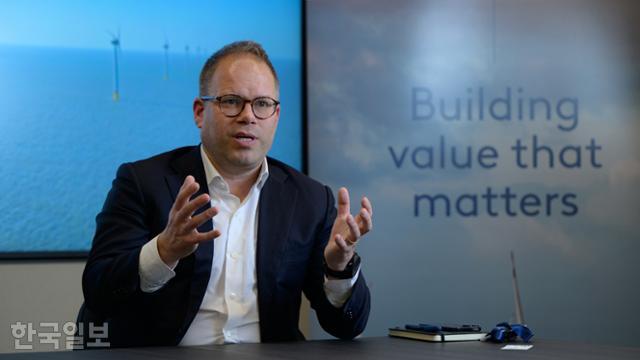
Thomas Wibe Poulsen, Head of Asia-Pacific at Copenhagen Infrastructure Partners (CIP), emphasized the potential of Korea's offshore wind power at CIP's Seoul office in Jongno-gu. Reporter Ha Sang-yoon
“Korea has already established the foundation for the floating offshore wind industry and possesses sufficient potential to lead the global market.”
Some companies preparing floating offshore wind projects off the coast of Ulsan have recently faced difficulties due to institutional and economic challenges. Despite the situation, Thomas Wibe Poulsen, Head of APAC & Partner at Copenhagen Infrastructure Partners (CIP), who is pushing forward the Haewoori Floating Offshore Wind Project in the same area, remains notably confident.
In a recent interview at CIP’s Seoul office, he emphasized that Korea’s market value remains high thanks to its excellent natural environment, the government’s strong commitment to renewable energy, and the presence of world-class supply chain companies. However, he repeatedly stressed that the industry as a whole must now focus on strengthening its “execution capability.”
Offshore wind power is divided into two types: fixed-bottom, where substructures are driven into the seabed like piles, and floating, where turbines are installed on platforms that float. Fixed-bottom types can only be built in shallow waters, while the newer floating technology can be deployed in deeper seas (over 50 meters), where winds are stronger. The world’s first commercial floating wind farm was established off the coast of Scotland in 2017.
Floating offshore wind is seen as opening the “second chapter” of offshore wind because it enables high-density energy generation while minimizing impact on local communities. Bloomberg New Energy Finance (BNEF) projects that floating offshore wind capacity will expand to 80GW by 2040, raising its share of total offshore wind from less than 1% in 2023 to 11%.
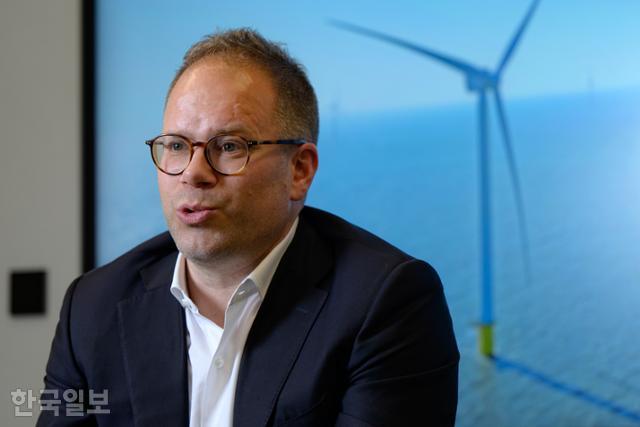
Poulsen said, “Compared to fixed-bottom, the floating offshore wind market is less mature, but the technology has already been proven.” He added, “Countries such as South Korea, Japan, and the UK, with good access to the sea, are places where floating offshore wind can play a major role.”
According to the government-funded Korea Research Institute of Ships and Ocean Engineering, Korea’s technical potential for offshore wind amounts to 78 GW for fixed-bottom, but a remarkable 546 GW for floating.
Poulsen particularly emphasized, “Korean companies already possess unrivaled capabilities in essential areas for offshore wind — substructures, shipbuilding, and subsea cables. Korea has the foundation for floating offshore wind to become a new industry.” He also noted the strong commitment of the Lee Jae-myung administration to renewable energy. From a developer’s perspective, Korea is a country where projects can be pursued with confidence.
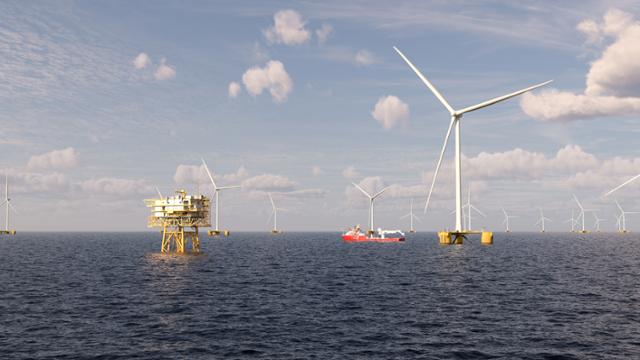
Nevertheless, floating offshore wind carries a heavier upfront cost burden compared to fixed-bottom. The recent domestic situation is also not very favorable. Of the six floating projects currently underway off the coast of Ulsan, two are facing difficulties. Equinor, Norway’s state-owned energy company, was the only developer to secure an auction award, but the project stalled during REC contract process. Meanwhile, Bada Energy, formed by a consortium of Korean energy firms, is winding down its project despite having invested KRW 100 billion.
He stressed the importance of institutional support to ensure offshore wind projects can be completed without setbacks. “Permitting and bidding are important, but ultimately the key is completing projects and producing electricity. Since developers are struggling to accelerate after bidding, the government needs to pay attention,” he said. At present, the only privately-led offshore wind project that has reached completion is the Jeonnam 1 Offshore Wind Farm, jointly developed by CIP and SK Innovation E&S.
Poulsen predicted, “The more execution capability improves to complete planned projects without setbacks, the more stable cycles will form across manufacturing and logistics. That will naturally boost production efficiency for companies and drive costs down.”
 목록으로
목록으로